Polyurethane Modified Silicone Softener, Innovative Textile
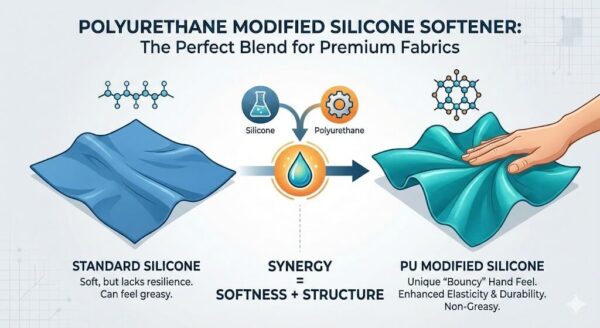 Our Polyurethane Modified Silicone softener represents a significant advancement in the field of Textile Finishing Auxiliaries. By utilizing an advanced Silicone Polyurethane Copolymer architecture, these materials are designed to overcome the limitations of traditional silicones softener, engineered to deliver the soft, luxurious hand feel of silicone with the exceptional durability and resilience of polyurethane.
Unlike a standard Textile Softening Agent that merely coats the surface, our technology synergizes the mechanical strength of polyurethane with the lubricity of polysiloxane. This hybrid structure creates a robust, flexible network on the fiber surface, ensuring performance that lasts.
Key Features and Typical Benefits
Technical Focus: The Hybrid Advantage
Potential Applications
Our product offering
Overview
- Polyurethane Modified Silicone Softener, Innovative Textile
- Key Features and Typical Benefits
- Technical Focus: The Hybrid Advantage
- Potential Applications
- Our product offering
- Silane Coupling Agent Manufacture Top10 in China
- Top 10 Silane Coupling Agent Manufacture in China
- Silane coupling agents play a crucial role in enhancing adhesion between organic and inorganic materials, making them essential in various industries, including coatings, adhesives, and composites.
- China is home to several leading silane coupling agent manufacture, known for their innovation and production capacity. Below is a list of the top 10 silane coupling agent manufacture in China.
- Dow Chemical
- Wacker Chemical
- Hubei Jianghan New Materials Co., Ltd
- Jiangxi Chenguang New Materials Co., Ltd.
- Jiangxi Hungpai New Materials Co., Ltd.
- Momentive Performance Materials
- Evonik Industries
- Tangshan Sunfar Silicon Industries Co., Ltd.
- Shin-Etsu Chemical
- HUBEI BLUESKY NEW MATERIAL INC.
- Featured Products
- Unveiling the New Face: A Journey of Innovation and Growth
- CHINA INTERDYE 2019. MEET CHEVELL AT BOOTH C331!
- WE WILL EXHIBIT AT CHINA INTERDYE 2018


 What is Silicone Antifoam and Defoamer?
 Antifoam VS defoamer
 Defoaming way
 How silicone antifoam agents work?
 Selecting the right silicone antifoam is crucial for optimizing coating performance, it plays an essential role in controlling foam, ensuring a smooth application and preventing defects.

 Silicone based antifoam main active substance is polysiloxanes (see Fig. 1)


 Silane Coupling Agents (SCA) is an organosilane compound featuring two key reactive groups: an organofunctional group (R) and a hydrolyzable group (X) bonded to a silicon atom (Si). Its general structure is R-Si-(X)₃. The hydrolyzable group, often an alkoxy group like methoxy or ethoxy, reacts with moisture to produce silanol groups (Si-OH). These silanol groups then bond with hydroxyl groups on the surface of inorganic materials, such as glass, silica, or metal oxides, forming stable siloxane bonds (Si-O-Substrate).
 Effectiveness of a Silane Coupling Agents largely depends on its molecular structure, particularly the type of organofunctional group (R) and the length of the alkyl chain (linker) that connects it to the silicon atom.

 Overview: DOWSIL is a brand under The Dow Chemical Company, which was formerly known as Dow Corning. It is a global leader in silicone technology and innovation, merging the strengths of both Dow and Dow Corning to enhance its silicone products and solutions across various industries.
 Overview: Founded in 1914, WACKER is a renowned German company specializing in organic silicone sealants and other specialty chemicals. It has established itself as a leader in the silicone and ethylene chemistry sectors.
 Overview: Established in 1998,
  Overview: Founded in 2001,
  Overview: Established in 2005,
  Overview: Originating from the U.S. in 1938, MOMENTIVE is known for its high-performance silicone products. It was previously part of GE-Toshiba before becoming an independent entity.
 Overview: EVONIK, formerly Degussa, is a leading specialty chemicals company from Germany that operates globally across several sectors including additives and smart materials.
 Overview:
  Overview: Established in 1926, Shin-Etsu is a leading Japanese supplier of high-tech materials, particularly known for its extensive range of silicone products used globally across multiple industries.
 Overview: Founded in 1999, New Blue Sky specializes in functional silane product development, production, and sales. It has become one of China’s leading companies in this field with significant production capacity.