

Amino Silane
Amino silane coupling agent is organosilane compound with amino functional group, used as adhesion promoter and surface modifier to improve bonding in coatings, composites, and various applications.
Chemical structure of amino silane coupler typically includes a reactive amino group and hydrolyzable alkoxysilyl groups, amino group interacts with organic materials, while silanol groups (formed after hydrolysis) bond with inorganic surfaces like glass, silica, or metals, creating a robust molecular bridge.
The general structure of amino silane coupling agent can be represented as:
R–Si(OR’)3-n(R”)n, where:
- R represents an organic group that can contain an amino group (e.g., –NH2, –NH–, etc.).
- OR’ are hydrolyzable alkoxy groups (e.g., methoxy or ethoxy).
- R” can be other organic substituents or hydrogen.
Amino silane coupling agents are used in various industries to improve product performance:
- Composites: Enhance adhesion between glass fibers and polymer matrices in fiberglass-reinforced plastics.
- Coatings and Adhesives: Improve bonding to substrates like metals, ceramics, and glass, increasing durability and weather resistance.
- Sealants: Provide better adhesion and flexibility in construction and automotive sealants.
- Surface Modification: Functionalize surfaces for better wettability and compatibility in nanotechnology and biomedical applications.
Read more: What is Silane
Molecular structure
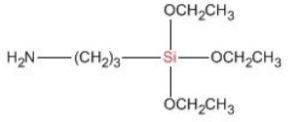
Typical physical properties
Chemical name: Amino propyl silane, 3-Aminopropyltriethoxysilane, Ameo silane
CAS No.: 919-30-2
EINECS No.: 213-048-4
Formula: C9H23NO3Si
Appearance: Colorless to yellowish transparent liquid
Refractive index(n25D): 1.4135~1.4235
Purity: 98%
Application
Maximizes the physical and electrical properties of mineral-filled phenolics, epoxies, polyamides, polybutylene terephthalate, and a host of other thermoset and thermoplastic composites. Filler wetting and dispersibility in the polymer matrix are also improved.
Improves adhesion between magnetic powder and organic resins and dispersion of magnetic powder inorganic resins. Also these magnetic appliances attain higher magnetic orientation andexcellent magnetic properties, higher mechanical strength, good processability, excellent weatheringresistance.
In glass-reinforced thermoset plastics, enhances the flexural, compressive, andinterlaminar shear strengths before and after exposure to humidity. Greatly improves wet electrical properties. With nitrile, polysulfide, epoxy, urethane, and adhesives and sealants, improves pigment dispersion and maximizes adhesion to glass, aluminum, and steel.
In glass fiber and mineral wool insulation, as a phenolics resin binder additive, amino propyl silane imparts moisture resistance and allows recovery after compression.
In shell molding foundry applications, amino propyl silane strengthens the bond between the phenolics binder and foundry sand.
In grinding wheels, amino propyl silane promotes an improved, water-resistant bond between the abrasivegrit and phenolics resin binder.
Possible Alternative
Wacker: APTE
DOWCorning: Z-6011
Shin-Etsu: KBE903
Momentive Silanes: A1100
Evonik Silane Dynasylan: AMEO
Molecular structure
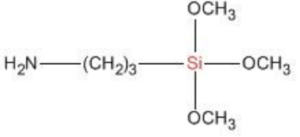
Typical physical properties
Chemical name: 3-Amino Propyl Trimethoxy Silane
CAS No.: 13822-56-5
EINECS No.: 237-511-5
Formula: C6H17NO3Si
Appearance: Colorless to yellowish transparent liquid
Refractive index(n25D): 1.4165~1.4265
Purity: 98%
Application
3-Amino Propyl Trimethoxy Silane is superior adhesion promoter in RTV silicones and other hybrid sealants.
3-Amino Propyl Trimethoxy Silane is excellent adhesion promoter for difficult substrates such as ABC,PVC ad Poly Shyrene.
3-Amino Propyl Trimethoxy Silane is useful component in primer systems for hybrid and polyurethane sealants .
Possible Alternative
KH-550 silane coupling agent
Wacker APTM
DOWCorning Z-6011
Shin-Etsu KBM903
Momentive Silanes A1110
Evonik silane Dynasylan
Molecular structure
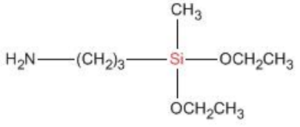
Typical physical properties
Chemical name: 3-Aminopropylmethyldiethoxysilane
CAS No.: 3179-76-8
EINECS No.: 221-660-8
Formula: C8H21NO2Si
Appearance: Colorless transparent liquid
Refractive index(n25D): 1.4200~1.4300
Purity: 97%
Application
Important or even essential constituent in many applications.
Important as an additive to cold-curing phenolic and furan foundry resins to improve the flexural strength of sand/resin elements with very long shelf life of resins
Possible Alternative
Wacker:
DOWCorning: Z-6015
Shin-Etsu: KBE902
Momentive Silanes: A2100
Evonik silane Dynasylan: 1505
Molecular structure
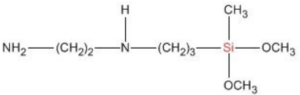
Typical physical properties
Chemical name: N-(2-Aminoethyl-3-aminopropyl)methydimethoxysilane
CAS No.: 3069-29-2
EINECS No.: 221-336-3
Formula: C8H22N2O2Si
Appearance: Colorless to yellowish transparent liquid
Refractive index(n25D): 1.4400~1.4550
Purity: 98%
Application
Provides superior elongation, flexibility and spreading at the interface as organo silane.
Improve adhesion between glass, mineral and metal surfaces and amino-reactive resins.
Improves adhesion,while maintaining good shelf stability as an additive in waterborne systems
Possible Alternative
Wacker: DAPDM
DOWCorning: Z-6436
Shin-Etsu: KBM602
Momentive Silanes: A2120
Evonik silane Dynasylan: 1411
Molecular structure
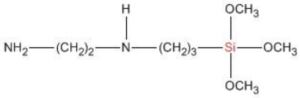
Typical physical properties
Chemical name: N-(2-Aminoethyl-3-aminopropyl)trimethoxysilane
CAS No.: 1760-24-3
EINECS No.: 212-164-2
Formula: C8H22N2O3Si
Appearance: Colorless to yellowish transparent liquid
Refractive index(n25D): 1.4380~1.4480
Purity: 98%
Application
Provides superior elongation, flexibility and spreading at the interface as organofunctional silane.
Improve adhesion between glass, mineral and metal surfaces and amino-reactive resins.
Improves adhesion,while maintaining good shelf stability as an additive in waterborne systems
Possible Alternative
Wacker: DAPTM
DOWCorning: ofs 6020 silane, 6094
Shin-Etsu: KBM603
Momentive Silanes: A1120
Evonik silane Dynasylan: DAMO
Molecular structure
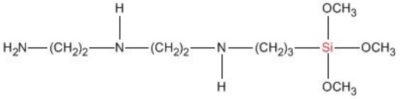
Typical physical properties
Chemical name: Diethylenetriaminopropyltrimethoxysilane
CAS No.: 35141-30-1
EINECS No.: 252-390-9
Formula: C10H27N3O3Si
Appearance: Yellowish transparent liquid
Refractive index(n25D): 1.4585~1.4595
Purity: 95%
Application
As additive to PVC-pastisols, Amino silane coupling agents can improve excellent adhesion between PVC and metals.
As corrosion inhibitor in liquid detergents, amino organofunctional silane can improve chip resistance of paint, cut down rust problem
Amino silane soupling agent can be used as size ingredient for glassfibers and glass fabrics.
Amino organo silane can be used as additives for fundry resins, like penolic, furan and melamine resins.
Amino silane coupler also can be used as primer or additive for adhesive and sealants.
Possible Alternative
Wacker:
DOWCorning: AY43-009
Shin-Etsu:
Momentive Silanes: A1130
Evonik silane Dynasylan: TRIAMO
Molecular structure
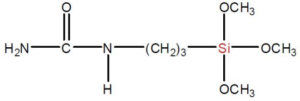
Typical physical properties
Chemical name: 3-Ureidopropyltrimethoxysilane
CAS No.: 23843-64-3
EINECS No.: 245-904-8
Formula: C7H18N2O4Si
Appearance: Colorless to yellowish transparent liquid
Refractive index(n25D): 1.4000~1.4400
Application
Provides superior elongation, flexibility and spreading at interface as a silane coupler.
Improve adhesion between glass, mineral and metal surfaces and amino-reactive resins.
Improves adhesion,while maintaining good shelf stability as an additive in waterborne systems
Possible Alternative
Wacker:
DOWCorning:
Shin-Etsu: KBM585
Momentive Silanes: A1524
Evonik silane Dynasylan:
Molecular structure
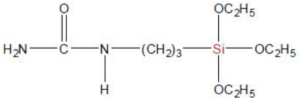
Typical physical properties
Chemical name: 3-Ureidopropyltriethoxysilane(50% in methanol)
CAS No.: 23779-32-0
EINECS No.: 245-876-7
Formula: C10H24N2O4Si
Appearance: Colorless to yellowish transparent liquid
Refractive index(n25D): 1.3850~1.4000
Application
Provides superior elongation, flexibility and spreading at interface as a amino silane.
Improve adhesion between glass, mineral and metal surfaces and amino-reactive resins.
Improves adhesion,while maintaining good shelf stability as an additive in waterborne systems
Possible Alternative
Wacker:
DOWCorning: Z6679
Shin-Etsu: KBE585
Momentive Silanes: A1160
Evonik silane Dynasylan: 2201
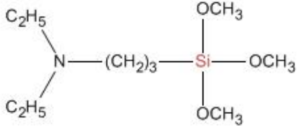
Molecular structure
Typical physical properties
Chemical name: 3-Diethylaminopropyltrimethoxysilane
CAS No.: 41051-80-3
EINECS No.: 255-192-0
Formula: C10H25NO3Si
Appearance: Colorless to yellowish transparent liquid
Refractive index(n25D): 1.4130~1.4330
Purity: 95%
Application
Used as catalyst for neutral cure 1-part RTV’S
Possible Alternative
Wacker:
DOWCorning:
Shin-Etsu:
Momentive Silanes:
Evonik silane Dynasylan:
Molecular structure
Typical physical properties
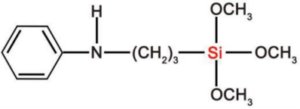
Chemical Name: n-Phenylaminopropyltrimethoxysilane
CAS No.: 3068-76-6
EINECS No.: 221-328-2
Formula: C12H21NO3Si
Appearance: Yellow to reddish brown liquid
Refractive Index(n25D): 1.4960~1.5160
Purity: 95%
Application
Applied in plastic products (including cables, glassfiber-reinforcement plastics etc.), rubber products, adhesives, coatings, pigments dispersion, inks, magnetic materials (plastic magnet andrubber magnet), metallic casting resins and resins concrete, etc.
Amino silane maximizes the physical and electrical properties of mineral-filled phenolics, epoxies, polyamides, polybutylene terephthalate, and a host of other thermoset and thermoplastic composites. Filler wetting and dispersibility in the polymer matrix are also improved.
Amino silane coupling agent improves adhesion between magnetic powder and organic resins and dispersion of magnetic powder inorganic resins. Also these magnetic appliances attain higher magnetic orientation andexcellent magnetic properties, higher mechanical strength, good processability, excellent weatheringresistance.
In glass-reinforced thermoset plastics, amino silane adhesion promoter enhances flexural, compressive, andinterlaminar shear strengths before and after exposure to humidity. Greatly improves wet electrical properties. With nitrile, polysulfide, epoxy, urethane, and adhesives and sealants, improves pigment dispersion and maximizes adhesion to glass, aluminum, and steel.
Glass-reinforced thermoplastics, polyamides, polyesters, andpolycarbonates exhibit increased flexural and tensile strengths before and after wet exposure.
In glass fiber and mineral wool insulation, as a phenolics resin binder additive, amino silane adhesion promoter imparts moisture resistance and allows recovery after compression.
In shell molding foundry applications, amino silane strengthens the bond between the phenolics binder and foundry sand.
In grinding wheels, amino silane coupling agent promotes an improved, water-resistant bond between the abrasivegrit and phenolics resin binder
Possible Alternative
Wacker: PAPTM
DOWCorning: Z-6083
Shin-Etsu: KBM-573
Momentive Silanes : Y9669
Evonik silane Dynasylan:
Molecular structure
Typical physical properties
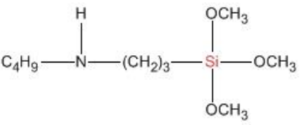
Chemical name: N-(n-butyl)-3-aminopropyltrimethoxysilane
CAS No.: 31024-56-3
EINECS No.: 250-437-8
Formula: C10H25NO3Si
Appearance: Colorless transparent liquid
Refractive index(n25D): 1.4146~1.4346
Purity: 95%
Application
Amino silane coupler can be used as a primer or additive and for the chemical modification of sealants and adhesives.
Amino organofunctional silane can be used as a size constituent or finish for glass fiber/glass fabric composites.
Amino organo silane can be used as an additive to phenolic, furan and melamine resins used in foundry resins.
Amino silane coupling agent can be used for pretreatment of fillers and pigments used in mineral-filled polymers.
Amino silane adhesion promoter can be used as an endcapper for polyurethanes
Possible Alternative
Wacker: BAPTM
DOWCorning:
Shin-Etsu:
Momentive Silanes
Evonik silane Dynasylan 1189
- Bifunctional Nature: Amino group can interact with organic polymers, while silane portion can bond with inorganic substrates such as glass or metals. This dual functionality is crucial for enhancing adhesion between different materials.
- Hydrolyzable Groups: Alkoxysilyl groups can undergo hydrolysis, allowing silane to form siloxane bonds (Si-O-Si) upon curing, which further strengthens material properties.
- ****Adhesion Promotion
- Coatings and Sealants: Amino silanes are widely used in coatings and sealants to improve adhesion to various substrates, including metals, plastics, and glass. They enhance bonding strength and durability of these products.
- Composite Materials: In composite applications, amino silane coupler improve bonding of resin systems to inorganic fillers and reinforcements, which enhances mechanical properties and overall performance.
****Surface Modification
- Improving Surface Properties: Amino silanes coupling agent can modify surface characteristics of materials, making them more hydrophobic or hydrophilic depending on the desired application. This is particularly useful in industries such as construction and automotive.
- Pre-treatment of Fillers: Amino organo silanes are often used for surface pretreatment of fillers and reinforcers in various formulations to enhance compatibility with polymer matrices.
****Curing Agents
- Curing Epoxy Resins: Amino silanes coupling agent can function as curing agents for epoxy and urethane resins. They facilitate crosslinking reactions that improve chemical resistance, UV stability, and hardness of final product.
****Electronics
- Electrical Insulation: In electronics industry, amino silanes are utilized to enhance electrical properties of insulating materials and improve adhesion in electronic packaging applications.